
Some background to the experiment
I first heard about bio-fermenting while staying on a permaculture farm in Costa Rica, Finica Luna Nueva. I listened fascinated as our tour guide, and farm owner, explained how they re-engergised the soil without having to use mountains of compost and animal manure. They of course have these things but it isn’t enough for the whole farm. Being a permaculture farm they wished to bring as little material in from the outside.
“Permaculture integrates land, resources, people and environment through mutually beneficial synergies – imitating the no waste closed loop systems seen in diverse natural systems”.
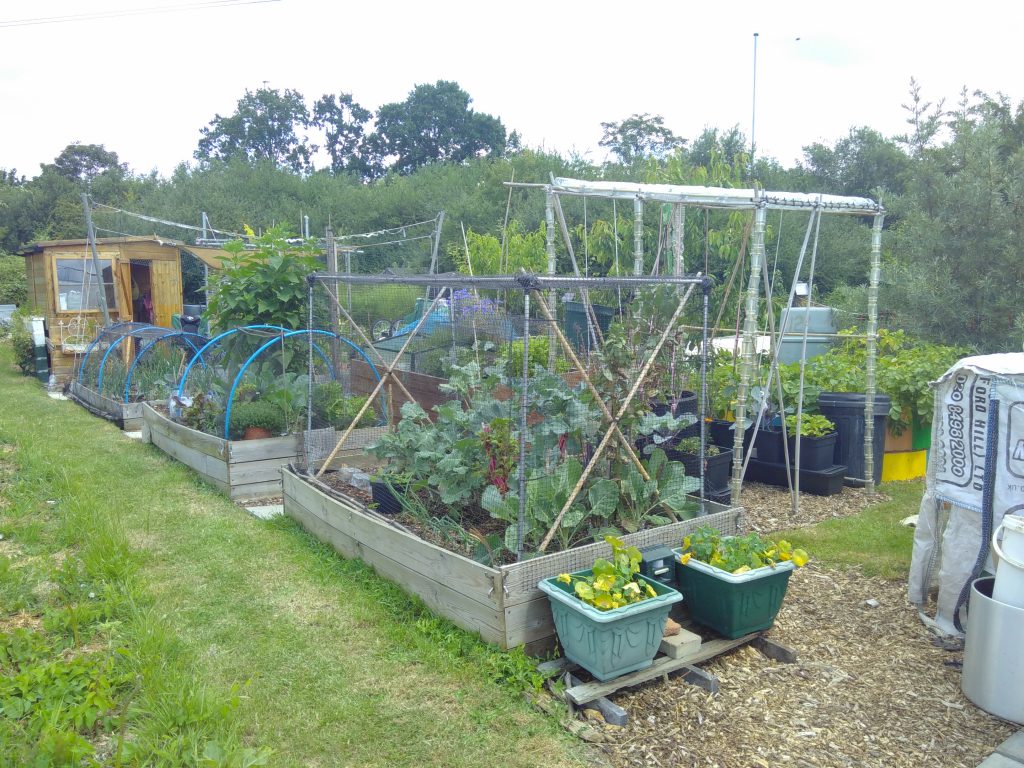
I have a half plot at an East London allotment, not a whole farm! The soil is not great, a heavy clay, with layers of new material we have added, so the plants could do with a boost. I love the idea of working with nature to make something more than the sum of its parts.
Some science behind bio-fermenting
Using the natural microbes on the organic material (leaves or manure) the mixture will ferment in aerobic conditions (without air) to release chemical compounds and minerals. Bio-fermenting makes the compounds more available to the plants roots than just putting the organic material straight on to the ground. The minerals will also stay in the soil for longer, instead of being washed away in the first rain shower. The other ingredients give the microbes food, and encourage them to breed.
If you are able to test your soil, see what minerals it is deficient in, then you can add some of these minerals to the bio-ferment as well. Something I hope to be able to try out in the future.
The Permaculture Research Institute have a great video on their web site showing how the professionals, with a lot more soil to fix, make a bio-fermenting.
For more information about Permaculture from a UK perspective, events, courses, and local groups, check out the Permaculture Association website.
My experiment
The bio-fermenting recipe is taken from the farm in Costa Rica. Simpler than the online ones I found. I wanted to keep this first batch small in case it all went wrong, so we used;

- 500g each of; leaves (not fresh and a little decomposed), molasses and wheat bran.
- I got the molasses and wheat bran from my local health food store, and the leaves from the edges of a wild space near the allotment.
- We also added 20g of an organic compost accelerator for an extra injection of microbes.
- Then we poured in 5.5 litres of water. My online research suggested that 4.5 litres (3x the mass) would be enough. We decided to add a bit extra as it seemed a little too dry.
- We then gave it a good mix and sealed the lid on the air tight fermenter with bubble airlock. The kind you use to make beer. It will stay in a shady place for 2 months. Hopefully after this time we will have a rich anaerobic plant food. It will be strained (the remaining matter will go on the compost heap), aerated and diluted. This will then be sprayed onto the plants to give them a boost of nutrients and good microbes.
The video
See my short video blog of Matt and I starting the bio-fermenting process;
The results?
In two months (ish) I’ll let you know how we got on. Hopefully we will have succeed in breeding anaerobic bugs in the right quantities. Or we will have bucket of stinky mess!!



5 Comments
Katy SkipTheBag
Sort of like a homemade bokashi! I love it. Posts like this would be great for the #WasteLessWednesday blog hop. There’s one open now!
Rosie (@greenrosielife)
This sounds really interesting and I look forward to hearing your results. I have a certain amount of animal manure I can use but not enough and getting manure from elsewhere is not ideal. This could be a great solution for me! #GoingGreenLinky
Marla
Very interesting article and experiment. I hope I am able to here the results of what occurred or didn’t occur. Shared on tweeter. Congatulations on being featured on #GoingGreenLinky. Have a healthy, happy & blessed day!
nikita
can i water the beer directly to my plants, and if not than what will happen
GreenDuckie
Lol, I don’t think that would be a good idea. The process is a ferment like beer is fermented, thats the only similarity!