
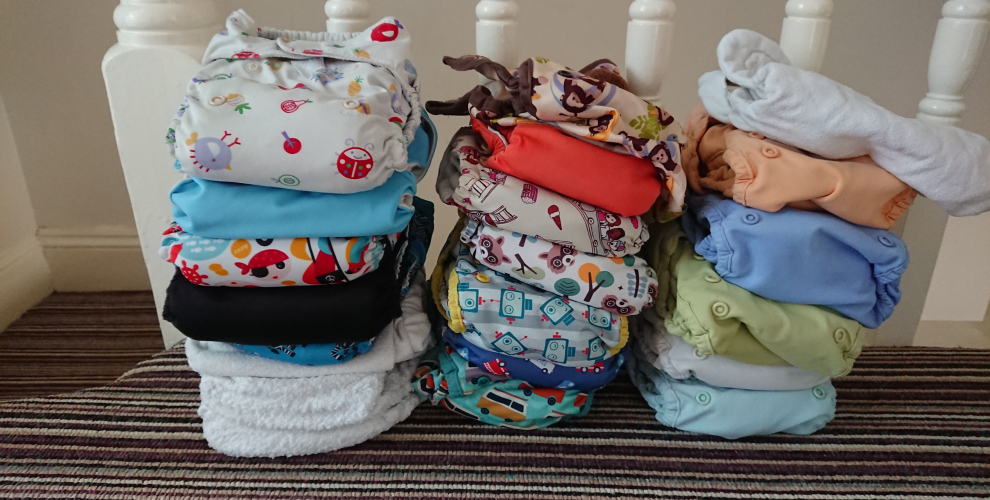
Guest post about cloth nappies by my friend Rebecca, parent of two very active boys. They were aged 2 and 5, at the time of this article. Covering; her personal journey, the financial and environmental costs of disposables, wider benefits and top tips.
Somewhere along the way during my first pregnancy, cloth nappies came onto my radar. I loved the idea that there was an opportunity to consume conscientiously. There seemed to be so much consuming required in preparation for the arrival of our bundle of joy!

My cloth nappy journey
There is a strong narrative that nappies are tricky to use. I’m guessing a hangover from when terry-towel nappies with a massive safety pin were the only option. Having friends experienced in using cloth nappies helped us to navigate the different types of nappies available. Providing support on how to use, and maintain, them. Keen not to find the whole process overwhelming, I began by gradually introducing cloth nappies alongside disposables. Eventually, I built up to cloth nappies being the only nappies that we used during the daytime. We also took them on holidays, and asked nursery staff to use them when I returned to work.
Using cloth nappies
So, to dispel the myths about cloths being overly complicated – they absolutely do not have to be! The variety of nappies available can be mind boggling to begin with; pre-folds, pockets, all-in-one or two-piece; hook and loop or poppers; birth-to-potty or sized; bamboo, cotton or microfibre! I found a birth-to-potty pocket nappy with hook and loop fastening as easy to use as a disposable. Family and nursery staff also had little difficulty with them. Our favourites were Totsbots. Not only were they easy to use, they had a slim fit, dried quickly, and had lots of lovely designs. Although I did enjoy experimenting with different brands and building up a “stash”. Babies come in all shapes and sizes and so it’s worth trying different brands until you find one that fits well for your baby.

Washing and wipes
We needed to wash the nappies every other day. It is important to use detergent only, no conditioner (fabric softener) as this affects the nappy’s absorbency. The nappies are placed in a dry bucket before washing, and hung to dry afterwards to keep the carbon footprint to a minimum. This became part of our weekly routine, and didn’t seem to us to be particularly burdensome. We’d try to hang them outside as often as possible, the UV rays naturally bleaches any stains. The Nappy Lady has a really useful section on her website about washing and drying. Before the boys were introduced to solid foods, we used washable liners with the nappies. Once they were on solids, we used flushable liners. These were disposed of before putting the used nappy in the bucket.
Alongside the cloth nappies, we used re-useable wipes. We bought the all in one kit from Cheeky Wipes and popped the used wipes in with the nappy bucket.

The environmental costs
It’s estimated that a baby will need around 4,000 nappies by the time they are potty trained. Equating to upwards of three billion disposable nappies being sent to landfill every year from the UK alone. Each disposable nappy contains plastic and chemicals, taking up to 500 years to decompose. Yes all nappies ever made still exist (unless incinerated). The human waste that goes with disposable nappies to landfill causes a further environmental hazard as this can end up in the water system. Eco disposable nappies, which contain far less plastic, and usually zero chemicals, can still take decades to decompose.
Cloth nappies are not without their environmental costs. The carbon emissions created by washing and drying each cloth nappy are said to equate to, or exceed those created by producing a disposable nappy.
On balance, a baby will only need around 20 cloth nappies by the time they are potty trained, meaning that there are far fewer carbon emissions going into the production and washing for each child, and a fraction of the nappies ending up on landfill.
Financial costs
The Guardian suggests that families using disposable nappies will spend around £1,000, plus on nappies and £250 on the associated paraphernalia (wipes, nappy sacks, bins) by the time their baby is potty trained.
The costs of cloth nappies can vary considerably with prefolds costing a few pounds each (with the cost of a cover on top), to brands such as Milovia costing upwards of £20 per nappy.
It is estimated that using cloth nappies will average out at about 0.03p per change compared to 8.7p per disposable.
Costs can be kept down by buying bundles (Fill Your Pants), buying pre-loved (Facebook groups, eBay), and looking for bargains during Real Nappy Week 22nd – 27th April 2019.
In addition to the nappy themselves, there is the cost of washing, liners, nappy bucket, bucket liners, wetbag (for out and about), and boosters. Although the initial outlay for cloth nappies can be quite significant, the overall costs are far less.
Further benefits of using cloth nappies
One of the major benefits to using cloth nappies for me was that it introduced me to a wider community of ethical parents, and I became more conscious around products that we were buying for our children. It wasn’t long until we were using cloth wipes for faces, hands and spills, as well as bottoms, recognising the huge environmental impact that disposable wipes have, as outlined in a recent BBC report. I also began thinking more about clothes, toys (more wooden, less plastic), and toiletries, which has evolved to us being more conscious with our general household purchases. I bought most of our products from Babi Pur, and joined their supportive Facebook group Babi Pur hangout.

My top tips
- Visit the Nappy Lady site which provides a wealth of information about anything you need to know regarding cloth nappies, she also does YouTube tutorials on different types of cloth nappies.
- Check your local authority websites for incentives, which can include cashback on nappies bought, or free trial packs. This link gives a list of which London councils provide incentives.
- If you’re not sure what type of cloth nappy would work best for you, then Fill your Pants offers a trial pack for £100, with a variety of nappies within it. You get your money back on any nappies you don’t want and then send back.


8 Comments
Cheryl Vernon
Thank you so much for this Rebecca ?
It’s been a really helpful read to a mum to be. I knew that real nappies were going to be the right choice for us but I wasn’t really certain where to start. I’ve already purchased my totsbots trial pack for only £28 for 3 nappies plus disposable and washable liners and found both your blog, their website helpful for a better understanding the system. Thanks again Rebecca and LGD ?
GreenDuckie
So great to hear you have found it useful!
Rebecca
Hi,
Thank you for your lovely comments on my post. Good luck with your cloth nappy journey. I’m sure you won’t regret it!
All the best with the arrival of your baby ?
Leta Elliott
We loved our cloth nappies, so easy to use, and very cute.
chickenruby
I tried the old terry towelling method when my 1st child was born, he is now 27. It was such an effort and mess to clean, there were no liners available which would’ve defeated the object anyway and I soon switched to pampers. My niece has used cloth nappies for her 3 boys and will continue to do so with her 4th baby due this month #goinggreen
Rosie (@greenrosielife)
I used cloth nappies (or real nappies as we always called them!) on both my boys and absolutely loved them. In fact, whilst I was happy when they potty trained a small part of me missed seeing them drying in the line. I would say to any parent of children in nappies – just do it, go for cloth nappies – they are easy (especially now with so many brands available to suit everyone), they are great for the environment and they save you money. Thank you for sharing this post of #GoingGreen – off to share it now!
karen reekie
Ah, I love this. I used cloth nappies almost 13 years ago before they were a thing again. I am so glad other parents are seeing that they are feasible.
#goinggreen